
NV Eye Surgery — Cornea Transplant Surgery
A Cloudy Cornea
Can Be Made Clear. Partially.
Partial corneal transplants replace only the diseased inner layer rather than the whole cornea. Dr. DeBry was the first surgeon in Las Vegas to perform DSEK, and brought DMEK to the city in 2016.
- DMEK transplants tissue one tenth the thickness of a human hair
- Typical DMEK recovery of four to six weeks instead of a year
- The longest experience with these procedures of any local surgeon
Is This Right for You?
Am I a Candidate for Cornea Transplant Surgery?
Partial transplants are best for corneal diseases that cause loss of endothelial cells and the swelling that follows. Thick corneal scarring points toward a different operation.
Fuchs’ dystrophy is the most common reason patients end up here. It is a fairly common degenerative condition in which endothelial cells degenerate slowly over years, first producing a slight haziness and eventually swelling the cornea outright. Surgery is recommended once visual symptoms start interfering with daily activities. Corneal edema from previous eye surgery is the other frequent path to a partial transplant.
The Procedure
What Is a Partial Corneal Transplant?
The cornea is the front window of the eye, like a windshield, and remarkably the body produces it perfectly clear. It has three layers. The epithelium is the thin outer skin. The stroma is the thickest part, though still only half a millimeter, and gives the cornea its strength. The endothelium is the thin inner lining, and its job is pumping fluid out of the stroma. When those endothelial cells are damaged by degeneration or previous eye surgery and lose their ability to pump, the cornea swells, turns white and cloudy, and vision fogs. A partial transplant replaces just that failing inner layer with healthy donor cells.
DMEK
Descemet’s Membrane Endothelial Keratoplasty transplants tissue only 10 microns thick, one tenth the width of a human hair. It is an exact anatomical replacement of the diseased layer.
DSEK
Descemet Stripping Endothelial Keratoplasty was the original partial transplant, replacing the endothelial layer with a somewhat thicker piece of donor tissue.
Positioning the Graft
A gas bubble is placed inside the eye to hold the new cells in position against the cornea while they attach.
Full-Thickness Transplant
If there are thick scars in the stroma, a full corneal transplant is probably necessary instead, since partial transplants only address endothelial disease.
Patient Reviews
Understanding the Difference
DMEK, DSEK, or a Full Transplant?
For decades a scarred or swollen cornea meant a full transplant. Partial transplants came later and overcame most of that operation’s weaknesses, then DMEK refined DSEK further. Which one applies depends on which corneal layers are actually diseased.
DMEK
Exact replacement of the diseased inner lining
- An exact anatomical replacement of the diseased tissue
- Better visual results and a better chance of reaching 20/20
- Faster visual recovery than DSEK
- A lower rejection rate
- Transplanted tissue is only 10 microns thick
- A technically demanding procedure requiring specific surgical experience
Most Advanced
DSEK
The original partial transplant technique
- Much quicker recovery than a full transplant
- No large incisions that weaken the cornea
- The cornea keeps a nicely round shape
- Effective for corneal diseases causing endothelial cell loss and swelling
- Thicker donor tissue than DMEK
- Somewhat lower chance of reaching 20/20 than DMEK
Well Established
Full Transplant (PKP)
Penetrating keratoplasty, used for decades
- The right operation when thick stromal scars are present
- Decades of use restoring vision
- Prolonged visual recovery, usually 12 months or more
- The eye is permanently weaker where the incisions were made
- Risk of severe vision loss from mild eye trauma afterward
When Scarring Is Deep
DMEK is not automatically the answer. If there are thick scars in the stroma, a full corneal transplant is probably necessary, because replacing the inner lining alone will not clear scarred tissue.
Step by Step
Your Cornea Transplant Surgery Journey
The recovery difference between a partial and a full transplant is the whole reason these procedures were developed.
1
Evaluation
- Examination of all three corneal layers
- Assessment of endothelial cell function and corneal swelling
- Determination of whether scarring requires a full transplant
- Discussion of DMEK versus DSEK for your cornea
- Donor tissue arranged through the eye bank
2
Surgery
- The diseased endothelial layer is removed
- Healthy donor endothelial cells are transplanted in its place
- DMEK tissue is 10 microns thick, DSEK somewhat thicker
- A gas bubble is placed to hold the new cells in position
- No large incisions are made, so the cornea is not weakened
3
Early Healing
- The transplanted cells attach to the inner cornea
- Positioning instructions help the gas bubble do its job
- The cornea begins pumping fluid out and clearing
- Corneal shape stays nicely round rather than becoming irregular
- Follow-up visits track cell attachment and clarity
4
Recovery
- Typical recovery runs four to six weeks
- Far faster than the 12 months or more a full transplant requires
- A better chance of reaching 20/20 with DMEK than with DSEK
- A lower rejection rate than full-thickness transplants
- Long-term monitoring of graft health continues
What to Expect
Expected Cornea Transplant Surgery Outcomes & Recovery
The advantage of a partial transplant is measured in months of recovery avoided and in corneal shape preserved.
What Patients Can Expect in the First 30 Days
- A gas bubble is placed in the eye to hold the new cells in position
- Follow positioning instructions carefully while the graft attaches
- Typical recovery runs four to six weeks
- Vision clears gradually as the cornea pumps fluid out and regains clarity
- Attend all follow-up visits so graft health can be monitored
- Graft health is monitored at follow-up visits over the long term
Informed Care
Safety & Risk Considerations
Partial corneal transplants were developed specifically to overcome the weaknesses of full-thickness transplant surgery, and patients undergoing DMEK typically experience faster recovery, better vision, and fewer surgical risks including rejection.
Safety Profile
- DMEK patients typically experience faster recovery, better vision, and fewer surgical risks than with older techniques
- No large incisions are made, so the cornea is not left weakened
- A lower rejection rate than DSEK, and both lower than full-thickness transplant
- Dr. DeBry was the first surgeon in Las Vegas to perform DSEK and has treated hundreds of patients over the last decade
- For a series of years he was the number one utilizer of corneal tissue from the Nevada Donor Network Eye Bank
Possible Side Effects
- Transplant rejection remains possible, though the rate is lower with DMEK than with DSEK or a full transplant
- A gas bubble inside the eye requires following positioning instructions while the new cells attach
- Vision clears gradually over four to six weeks rather than immediately
- If thick corneal scarring is present, a partial transplant will not clear it and a full transplant may still be needed
How We Minimize Risk
The Longest Local Experience
Dr. DeBry performed the first DSEK in Las Vegas and brought DMEK to the city in 2016, giving him the longest experience with these procedures of any local surgeon.
Matching Procedure to Pathology
Partial transplants are used for endothelial disease and swelling. Where thick stromal scars exist, we recommend a full transplant rather than a procedure that cannot address the problem.
Established Tissue Supply
A long working relationship with the Nevada Donor Network Eye Bank, where this practice was for years the leading user of corneal tissue in the state.
Why NV EYE SURGERY
Why Choose Us for Corneal Surgery
Partial transplants are technically demanding, and the surgeon’s experience with the specific technique is the variable that matters most.
First With Both Techniques
Dr. DeBry performed the first DSEK in Las Vegas, then in 2016 was again the first to bring DMEK to patients here. He has the longest experience with these procedures of any local surgeon.
Fellowship in Corneal Disease
He was one of only four physicians selected nationally for a fellowship in corneal, external disease, and refractive surgery at the Bascom Palmer Eye Institute in Miami.
Volume That Compounds
Hundreds of patients treated over the last decade, and for a series of years the leading user of corneal tissue from the Nevada Donor Network Eye Bank.
Our Team
Meet Your Corneal Surgeon
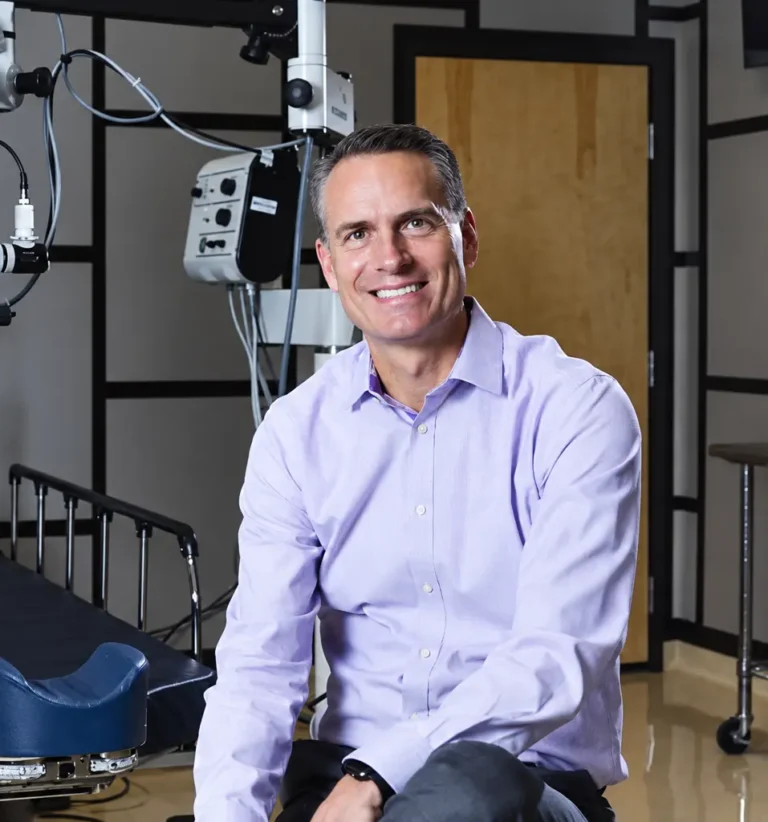
Corneal transplant surgery here is performed by a fellowship-trained corneal specialist who introduced both DSEK and DMEK to Las Vegas, with pre-operative evaluation and graft monitoring handled by our clinical team.
Find Us
Cornea Transplant Surgery in Henderson & Las Vegas
Corneal evaluations and post-transplant monitoring at both Southern Nevada offices.
Coverage & Financing
Cost & Insurance
Corneal transplant surgery for a sight-threatening condition is medical care, not elective, which places it under your medical insurance rather than a vision plan.
Insurance Coverage
Office visits and procedures for corneal disease fall under medical insurance. Your plan determines your co-pay and deductible, and we collect co-pays at the time of service.
- Common plans accepted include Medicare, Blue Cross Blue Shield, Cigna, Aetna, Culinary, UMR, Teachers, United HealthCare, Sierra Health and Life, and TriCare
- We take Medicare but cannot see Senior Dimensions or Humana Gold Medicare Advantage patients except in rare authorized cases
- Some plans require a referral from your primary care doctor to see a specialist
- Text a photo of your insurance card to (702) 935-5746 and our staff will confirm your coverage
Without Insurance
You can see one of our doctors even if you have no medical insurance or we are not on your plan. Corneal disease is progressive, and delay costs vision.
- Many plans include out-of-network benefits you can claim against for partial reimbursement
- Paying cash per visit is a workable option for evaluation and monitoring
- We have many payment options and will work with you to find a path to care
- VA community care may apply with a referral from the Las Vegas VA Eye Clinic
Flexible financing available. We work with CareCredit to offer low- and no-interest payment plans for care not covered by insurance. Ask about your options at your visit. Results may vary. Individual results are not guaranteed. Financing subject to credit approval. See office for complete terms and conditions.
locationsCommon Questions
Frequently Asked Questions
Questions patients bring after a Fuchs’ dystrophy or corneal edema diagnosis.
What is DMEK?
Descemet’s Membrane Endothelial Keratoplasty, a partial corneal transplant. Descemet’s Membrane is the thin inner lining of the cornea, and it holds the endothelial cells that keep the cornea clear. In DMEK the damaged cells are removed and healthy donor cells transplanted in their place.
How is DMEK different from DSEK?
They are very similar procedures, but DMEK transplants tissue only 10 microns thick, one tenth the width of a human hair. That thinner tissue means faster recovery, a better chance at 20/20 vision, and a lower rejection rate.
Why not just have a full corneal transplant?
Full transplants have restored vision for decades, but they have real weaknesses. Best vision takes 12 months or more, the eye stays permanently weaker where the incisions were made, leaving a risk of severe vision loss from mild trauma, and sutures often leave the cornea irregularly shaped.
What is Fuchs’ dystrophy?
A fairly common degenerative condition where the endothelial cells lining the inner cornea slowly degenerate. Those cells pump fluid out of the cornea to keep it clear. As they fail, vision hazes and eventually the cornea swells. DSEK or DMEK replaces the failing cells with healthy ones. To learn more, see the MedlinePlus article on Fuchs’ dystrophy or the Cornea Research Foundation’s overview.
How long is recovery?
Typically four to six weeks for DMEK, compared with 12 months or more for a full-thickness transplant. DSEK is also much quicker than a full transplant, with a somewhat longer visual recovery than DMEK. A gas bubble is placed in the eye to hold the new cells in position while they attach.
Where does the tissue come from?
The transplant is provided as a gift from an eye donor who recently died. Our practice has worked with the Nevada Donor Network Eye Bank for years, and for a stretch was its single largest user of corneal tissue.
Ready When You Are
Schedule Your Free Consultation
Most patients see results within 24 hours. Consultations are available at all four locations, online scheduling takes less than two minutes.
Schedule Online